 01
01 02
02 03
03 04
04Sections
Choose the commercial wedge by finding the one product a named food buyer can specify, trial and order now, and lead with it. The platform tells the market how large the company could become. The product tells a customer what they can use today, and in food tech the buyer decides on that first.
Why food-tech founders lead with the platform
Founders often reverse that order because the platform is the part they built and the part investors reward. A fermentation process, a cell line, a strain library or a bioprocess can make many outputs, and that range is the basis of a long-term strategy. The Good Food Institute's state of the industry report on fermentation covers meat, seafood, eggs, dairy and ingredients in a single sector review, which shows how many directions one production approach can point.
The buyer at a food manufacturer sits in one of those directions. When the homepage opens on the platform, that buyer has to translate it into a product decision alone, and many move on to a supplier who has done that work for them. We set out the general version of this problem, across climate and biotech, in technology versus product. This piece stays with food buyers and the entry points they use, which run through formulation, regulatory status and supplier qualification.
What does a food buyer need to hear first?
A food buyer needs to know what the ingredient or product is, where it fits in their range, which specification matters, what result it creates in the finished product, how it is supplied, what integration it requires and what evidence exists. An R&D manager reads for performance in a format they recognise. Procurement reads for capacity, price and continuity. A retailer's own-label team reads for claims and labelling.
Regulation makes the product-first order practical as well as persuasive. Approvals attach to specific substances and specific uses. In the United States, the FDA publishes a GRAS notice inventory, and each new output from a platform may need its own route to market. A buyer can only order the output that is cleared, specified and available today. The platform becomes relevant once that product is commercially legible.
Koralo and the wider opportunity
Koralo co-ferments microalgae and mycelium. It set out to make a fish alternative. Developing that product surfaced bioactivity in the ingredient, and early evidence pointed to a gut health effect. The opportunity widened to a functional ingredient across food, beverage and animal nutrition.
That widening creates a real positioning problem. By July 2025 the Koralo deck carried four propositions at once, and the fish-alternative story stayed memorable after the commercial centre had moved. The answer was to keep the seafood story as the route to the discovery and to show the causal path from one product to the larger opportunity.
- We built this
- We learnt this
- The ingredient demonstrated this
- That evidence opens this larger opportunity
The platform becomes credible because the product produced the discovery. A jump from one product to an open-ended platform loses the evidence that makes the wider claim believable. The Koralo case shows the work.
Unibio and the protein story
Unibio shows the same principle in industrial protein. The company uses gas fermentation to turn methane into a protein for feed, sold as Uniprotein. The production process is the company's technical foundation. A feed producer still decides on the protein, its nutritional profile, its price against incumbent protein sources and the reliability of supply.
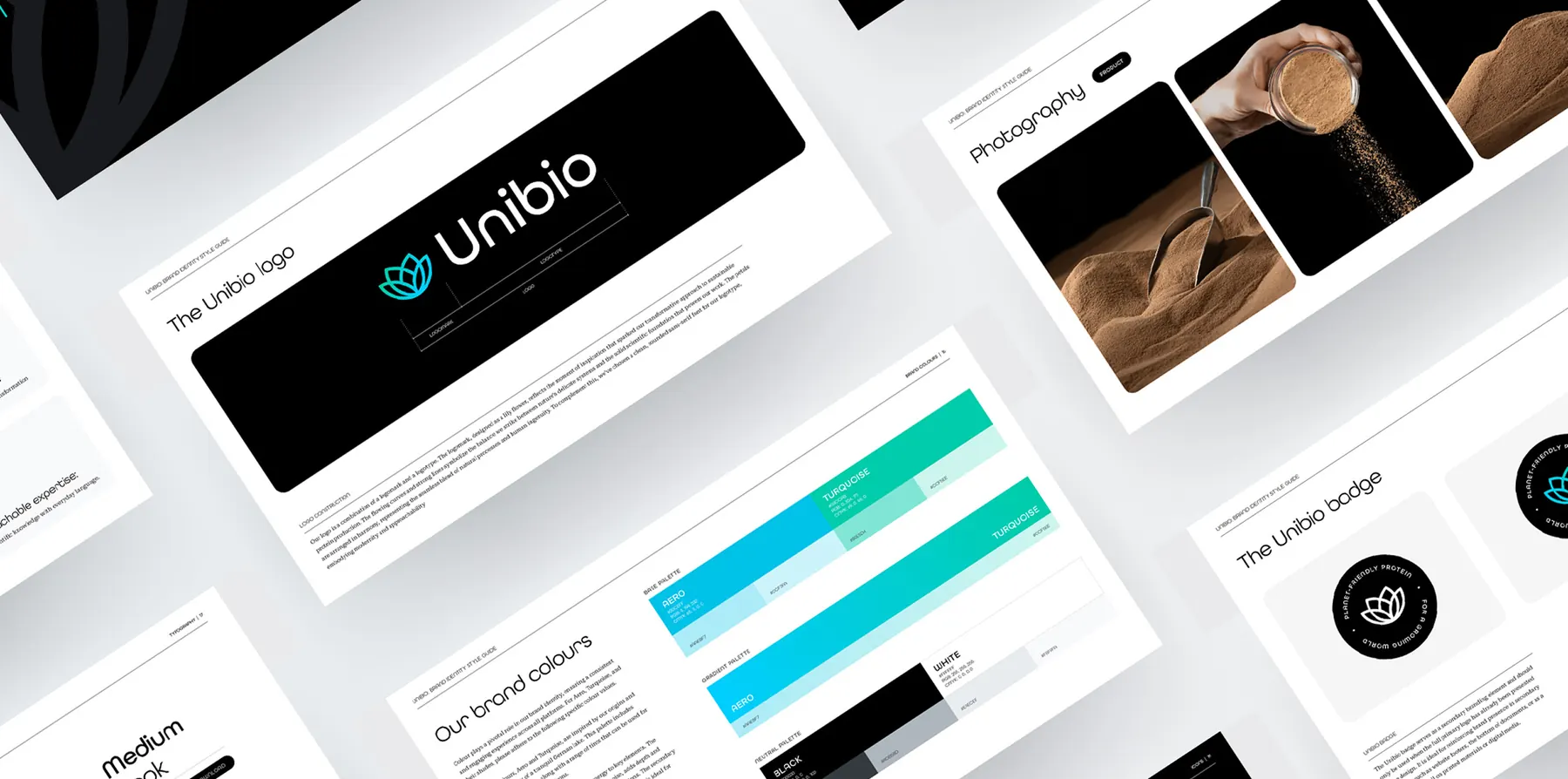
When Brighter Future worked with Unibio, we repositioned the company around the protein product, with the technology presented as the evidence behind it. The line that carried the work was "Lead with protein. Let the technology prove it." The company's own announcements follow the same order. Unibio reported its first commercial shipment of Uniprotein in Europe, to Danish Agro, and announced a partnership to deliver Qatar's first Uniprotein plant. The product is the subject of both headlines. The Unibio case covers the engagement.
Investors and buyers read at different altitudes
An investor may reasonably ask how the first product becomes a multi-product company. A buyer may care about a single application for the life of the contract. Both views can come from one source of truth, told with different emphasis.
Buyer cut: product → application → proof → supply → integration. Investor cut: market shift → wedge product → proof → platform → expansion → economics.
The facts are shared and the sequence changes. Policy is moving the same way. The European Commission's consultation on industrial biotechnology and biomanufacturing asks how the sector can build a stronger business case, including demand in lead markets. Solve audience differences with clear routes on the website and separate decks. A homepage written to be vague enough for everyone serves nobody well.
How to choose the wedge
A wedge has a specific buyer, a problem that buyer will pay to solve, a clear application, evidence of performance, plausible economics and a route to supply. It can be much smaller than the company the founders intend to build. Its job is to make the first market real, generate revenue and produce the evidence the platform story will later rely on.
"Platform" can make an early company sound larger than it is, and investors and technical buyers test the claim. A real platform has produced more than one commercially relevant output, even at pilot scale, and has a repeatable process for developing the next one. Each new output may still need its own regulatory dossier, downstream processing or plant, and the story should say so. Where the evidence is mostly future possibility, call it possibility. A slide with ten markets and no evidence for nine of them weakens the one market that is real.
Use the platform to explain leverage
Once the wedge is clear, the platform can explain what carries over to the next product. It might be the organism, the process, the feedstock, the manufacturing system, the data, the regulatory work or access to the same customers. The more that transfers, the stronger the platform case. That analysis does more for an investor than a market map, and it tells a buyer the supplier will still be around.
Keep the product visible on the website while you do this. Give the product and its applications their own routes, with specification sheets, regulatory status and a clear way to request samples. The technology page can explain the platform in depth for the technical evaluator and the investor. For the layers a buyer checks before ordering, see positioning food tech for B2B buyers.
How to test your own order
For most B2B food-tech companies the sequence holds in three lines.
Product earns relevance. Evidence earns confidence. Platform earns strategic imagination.
To test your own materials, open your homepage and count the sentences before a visitor learns the name of something they can buy. Then ask a buyer in your target market to describe your product after one minute on the site. If they describe your process, move the product up. If they describe the product and ask what else you can make, the platform has found its place.
Brighter Future helps food and biotech companies choose and tell their commercial wedge through our positioning work.
Sources and further reading
- Fermentation, meat, seafood, eggs, dairy and ingredients, state of the industry, Good Food Institute
- GRAS notice inventory, US Food and Drug Administration
- Commission seeks feedback on industrial biotechnology and biomanufacturing, European Commission, 2026
- Unibio makes its first commercial shipment of Uniprotein in Europe, Unibio
Tell us what needs to move.
Bring the brief if it is clear. If it is unclear, tell us where the work is stuck.
Bring us the problem