 01
01 02
02 03
03 04
04Sections
This guide sets out the seven decisions a brand strategy has to make. For why those decisions come before marketing spend, read Brand Strategy Before Marketing: What Climate Companies Need to Decide First.
Brand strategy for climate tech is the set of decisions a company makes before anyone designs a logo or writes a homepage. It settles what the company builds and sells, why the work matters, who must understand it first, what position it can prove, what evidence carries its claims, how the brand behaves and what the team changes next. The logo, website and deck then make those decisions visible. When design becomes the place where the decisions get made, they get made by accident.
Climate and science-led companies ask their brands to carry unusual weight. They explain unfamiliar products to investors, buyers, regulators and scientists at once, and they support long buying cycles in markets that are themselves changing. Many of them sell technology that is still maturing. The IEA tracks the share of emissions reductions needed for net zero by 2050 that must come from technologies that are not yet commercially available, and the US Department of Energy runs a whole programme on the path from demonstration to commercial liftoff. A brand built on that kind of technology has to earn belief while the proof is still arriving. The seven decisions below are the ones we see companies make, or skip, in that order.
- 01What you build and sellThe offer a buyer can act on.
- 02The problem you commit toA boundary that shapes what you refuse.
- 03Who needs you firstThe audience for the decision at hand.
- 04What changed in the marketThe shift that makes the company relevant now.
- 05The evidence behind the claimsWhat you can prove, and how well.
- 06How the brand behavesVoice, identity and conduct that fit the proof.
- 07What changes afterThe decisions the strategy makes easier.
Design expresses these decisions. It cannot make them.
1. What are you building and selling?
Start with structure. List every product, service, project, platform and pilot the company offers today. Decide how they relate, which one the market should meet first, which names deserve to become brands and which are internal capabilities. It is the least glamorous part of brand strategy and the one that shapes everything after it.
A confusing offer produces a confusing website. A team cannot communicate a product hierarchy until it has chosen one. When copywriters are asked to simplify a proposition three times and it still reads as crowded, the problem usually sits in the commercial logic. Our piece on offer architecture sets out how to sort entry offers, core products and capabilities before anyone touches the navigation.
This decision also sets scope for the rest of the work. A company with one product and one buyer needs a lighter strategy than a company running a technology licence, a project pipeline and a data service under one name.
2. What problem are you committed to?
Purpose, mission, vision and values often collapse into four versions of the same inspiring sentence. Each has a separate job. Purpose names the wrong, gap or need beneath the work. Mission says what the company does about it. Vision describes the changed world the company works towards and its role inside that world. Values set standards for behaviour.
Each of these should help someone make a real decision. A purpose statement earns its place when it helps the team decide which customer to take, which market to leave or which claim to refuse. Statements that only appear on the About page are still decoration.
For climate companies the purpose often sits close to the science. A team that captures methane, restores forests or ferments protein usually knows the harm it addresses in precise terms. The strategic work is turning that precision into a sentence a buyer, an investor and a new hire can all repeat. Our Story System gives each of these its own story, from Origin and Purpose through to Vision and Impact.
3. Who needs to understand you first?
Climate companies can have many stakeholders and still need one primary audience. An investor, a corporate buyer, a regulator, a scientist and a new employee each make different decisions with different evidence. Choose the group whose belief matters most to the objective in front of you, whether that is a round, a first commercial contract or a certification.
Then study the person inside that group through four lenses. Look at the pressure they carry, what they want, what they doubt and the moment they decide. Use evidence from real conversations. A detailed fictional persona hides uncertainty behind a name and a stock photo. Ten recorded calls with buyers will teach a team more than a workshop of assumptions.
The primary audience can change over time. A company raising a Series A may lead with investors this year and with procurement teams next year. The strategy should say which audience leads now and when that is expected to shift.
4. What changed in the market?
Positioning answers where the company sits relative to the alternatives a buyer already has. In climate markets it gets stronger when it sits inside a real shift. A regulation takes effect, an incumbent input becomes expensive, customers face new reporting pressure, infrastructure arrives, a supply gap opens or a technology crosses a cost threshold. The company enters the story once the audience can see why the old situation no longer holds. An external change is context that makes the customer decision worth investigating. Demand still has to be shown.
A credible position sits where three things meet.
Need: what the audience already cares about.
Gap: what the current market or alternative leaves unsolved.
Provable advantage: what the company can legitimately demonstrate.
Most brand exercises weaken at the third point. A workshop can choose words such as "most sustainable", "best performing" or "lowest cost" faster than a lab can prove them, and the evidence has to carry every one of them. Our companion piece on how to position climate tech goes deeper, from mapping the market change to writing the final line.
5. What evidence carries the claims?
Every brand makes claims, and in climate those claims face more scrutiny each year. The UK government publishes guidance on making environmental claims about goods and services, built around the Green Claims Code. In the EU, the Directive on Empowering Consumers for the Green Transition sets new rules for environmental claims made to consumers. Business-to-business companies feel the effect too, because their customers repeat their claims to end buyers and need the evidence behind them.
Treat evidence as a design input. For each claim the company wants to make, record the proof that supports it today, the proof still being collected and the date that proof is expected. Claims with thin support get softer wording or wait. Claims with strong support move to the front of the story.
This register also helps investors. A diligence team reads a claim and asks where the data sits. A company that can point to a test report, a third-party verification or a signed pilot answers that question before it is asked. The same register feeds the website, the data room and the sales deck, so every channel draws on one set of facts.
Apply the same discipline to the strategy itself. Our course, Build the Strategy Before the Brand, asks teams to record the evidence and the confidence behind each answer alongside the answer. A primary audience chosen from repeated customer observation carries more weight than one picked in a workshop because it sounded attractive. A value proposition backed by repeat purchasing outranks one inferred from founder intuition. An advantage proven under a defined test sits in a different category from a claim the team hopes to make true. The market can move while the brand is being built, and a strategy that shows its confidence levels tells the team what to test next.
6. How should the brand behave?
Voice and visual identity become strategic when they help a team make repeatable choices. Decide how the company sounds when it explains uncertainty, which words it refuses to use and how directly it challenges an incumbent system. Decide what the design should signal. Technical rigour, industrial readiness, institutional trust, frontier ambition and consumer appeal each call for different typography, imagery and pace.
Fronterra shows why this matters. The company develops and operates forest carbon and biodiversity projects in Peru, with four Verra-listed projects across more than 1.6 million hectares. It had a serious project track record, yet its public face read like a mission-led initiative, which made the evidence hard to inspect. Fronterra needed its capability made visible more than it needed a prettier website. The strategy surfaced the operator, summed up as "Originate. Engineer. Operate.", and the identity, website and investor deck were built around that reality. Design followed the position.
7. What changes after the strategy?
A brand strategy is unfinished until it changes what people do on Monday. It should name the pages to rewrite, the deck to rebuild, the offers to simplify, the proof to collect and the claims to remove. It should say which customer interviews still need to happen and who owns the system once the project ends.
A 30, 60 and 90 day plan works well here. The first month usually covers the homepage, the investor deck and the sales one-pager. The second covers product pages, case studies and the proof register. The third covers social profiles, bios, event copy and templates. A strategy that cannot produce this plan is still a diagnosis. Name one person who approves new claims, pages and decks against the strategy, and give them the evidence register to work from.
What this looks like across real climate companies
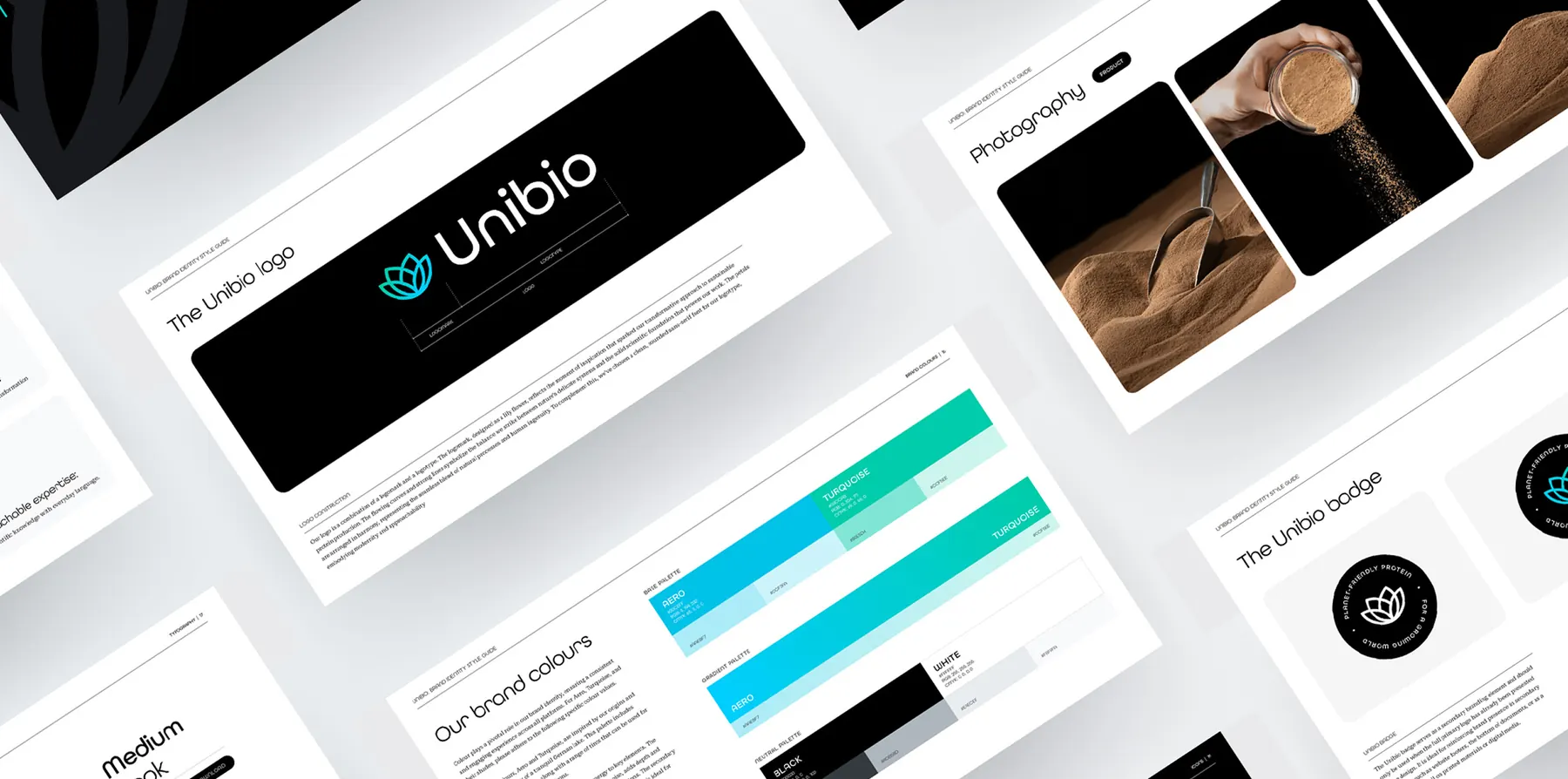
The seven decisions look different in each company, and none of the problems below began with visual identity. Unibio makes protein for feed through gas fermentation. Its technology was sophisticated, and the product needed to move forward in the story so a buyer could see what they were evaluating. The line became "Lead with protein. Let the technology prove it."
Eeden, a textile recycler, needed the market around the company made visible, through upcoming regulation, future demand for recycled textile inputs and the gap with available supply. Koralo set out to make a fish alternative, found bioactivity in its ingredient and saw the opportunity widen to a functional ingredient across food, beverage and animal nutrition. Its public story needed to catch up with the business it had become. The deliverables differed in each case because the underlying decisions differed. The common work was diagnosis, choice and evidence.
When should a climate company wait?
Some companies need learning more than codification. The buyer may be unclear, the product may still be changing each quarter, demand may be unproven, the economics may be unstable or a single regulatory outcome may decide the market. In those cases, lightweight messaging and structured market tests are worth more than a full brand programme.
Brand strategy cannot create certainty the business lacks. It can make the decisions that are ready, flag the ones that need evidence and build a coherent system around both. A middle path suits many early teams. Settle the offer, the primary audience and the evidence register now, since those hold up through most pivots. Leave naming, full identity and the long list of brand assets until the market has answered the open questions.
How to start your own brand strategy
Test your current position against the seven decisions before you brief a designer. Ask three people on the leadership team to answer each one in a sentence, separately and in writing. Where the answers match, the decision is made and design can express it. Where they differ, the team has found the work.
Most companies find two or three gaps, usually in offer structure, evidence and audience. Close those first. The finished strategy leaves a company that knows what it says yes to, what it says no to, what it can prove and how that truth should travel across the rooms that matter.
Brighter Future runs this work as brand strategy and identity for climate, science and frontier-technology companies.
Sources and further reading
Tell us what needs to move.
Bring the brief if it is clear. If it is unclear, tell us where the work is stuck.
Bring us the problem