 01
01 02
02 03
03 04
04
Sections
A rebrand can be beautiful and still leave the hard problem untouched. The website looks better, the type is sharper and the launch film lands. Then, three weeks later, sales is rewriting the proposition again, the founder is repairing another investor deck, product is describing the company differently from marketing and every important piece of communication still needs somebody senior to translate it. The organisation has changed its appearance without changing the system underneath it.
That distinction matters because some of the most important work in a rebrand happens nowhere near the logo. It happens in the decisions a leadership team finally agrees on, in the evidence that moves forward, in the way a product is explained to a buyer and in whether somebody else can carry the company into a room without the founder being there to repair the story.
A brand is the understanding underneath the design
In our Brand Strategy work, we define brand as what people understand, remember and believe about an organisation. Design makes that understanding visible. That is why identity work cannot carry the whole job.
If the organisation has not settled what it is, who it is for, what it can prove, where it is distinct and what important audiences need to understand, the visual system receives an impossible brief. It can make uncertainty look coherent while the uncertainty itself remains.
This is also why a strategic rebrand often starts further upstream than the client expects. The request may be for a new identity, website or deck. The actual problem may sit in positioning, offer architecture, audience logic, evidence, leadership alignment or the order in which the company explains itself. A good process should be willing to find that out before the visual work begins.
The rebrand has to survive the business
One useful way to test whether a rebrand has gone deep enough is to look across six places.
Leadership
Can the leadership team describe the company in a way that agrees on category, proposition, ambition and evidence?
Product
Does the product story explain what changes for the customer and how the mechanism creates that change?
Sales and partnerships
Can the story survive a live commercial conversation and be adapted without turning into a different company?
Fundraising
Does the investor material connect evidence, market, risk, team and the milestone the capital unlocks?
Digital
Can different audiences find the route and proof they need without reconstructing the company themselves?
Internal use
Can the team produce the next proposal, deck, report, launch page or hiring asset without recreating the brand from memory?
The aim is a shared strategic source that can flex without breaking. If the founder remains the brand API for every important piece of communication, the system is not yet doing enough work.
Strategy needs an order
Our current Brand Strategy framework moves through five stages. First comes orientation and foundation, which covers the organisation, offers, decision flow and brand architecture. Then brand essence sets out purpose, mission, vision and values, written so they create real choices and avoid decorative statements.
Next comes brand positioning, covering audience, customer value, alternatives, competitive advantage and the position the organisation can credibly occupy. Then brand expression covers personality, voice and visual direction. Finally comes action, which sets out the touchpoints, channels, roadmap and ownership that make the strategy usable. The order matters because later work inherits earlier ambiguity. A weak foundation stays weak however beautifully the identity is executed.
Story is what lets the strategy travel
Strategy can be clear and still feel inert. People rarely remember an internal strategy document as a strategy document. They remember moments, choices, consequences and transformations.
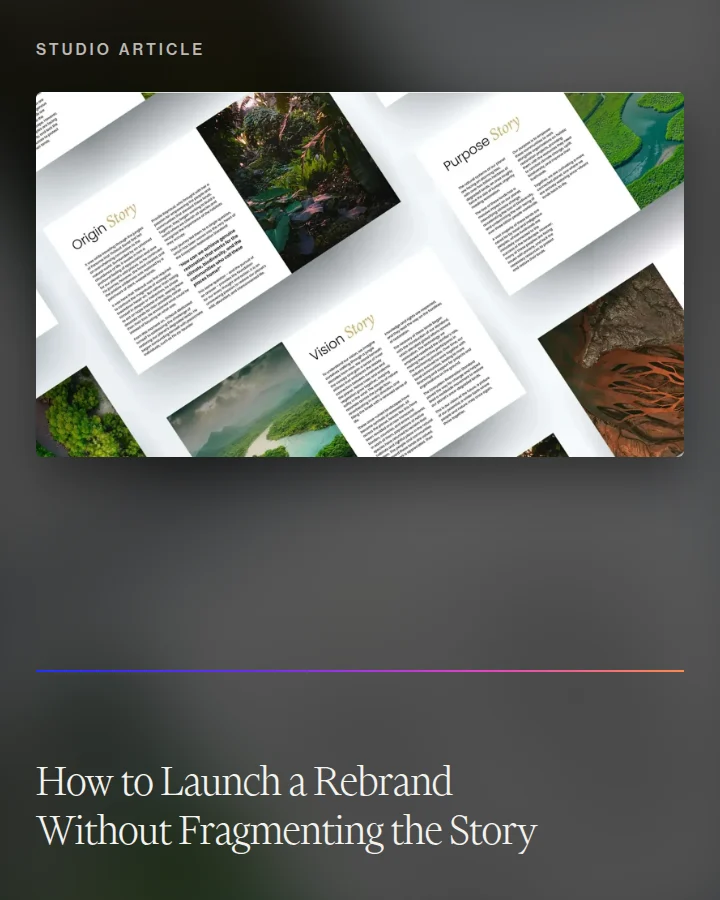
That is why our Story System sits between strategic clarity and public communication. It separates Origin, Purpose, Vision, Customer, Product and Impact so one piece of copy does not have to do six jobs at once. We build the deep versions first, then extract the right parts for the website, sales, investor materials, leadership, hiring and partnerships.
This is also where the neuroscience becomes useful, provided it stays modest. Concrete language can support mental simulation. Research on speaker-listener neural coupling suggests successful communication can involve patterns of listener activity tracking the speaker. The practical lesson is to give important ideas enough specificity that people can picture and carry them.
A Product Story becomes stronger when a customer can see the moment the product changes something. An Impact Story becomes stronger when the evidence sits inside a before and after the audience can understand. A founder story becomes stronger when a real choice earns the credibility that adjectives can only claim.
Fronterra and Fair Carbon show two different versions of the problem
Fronterra already had the operating reality. The company had projects, experience and a serious model. The public face made it look smaller than the operator behind it.
The rebrand therefore had to work across positioning, narrative, identity, website architecture and investor materials. Originate. Engineer. Operate. gave the work a spine. Projects and track record moved forward, and the investor materials used the same evidence logic. The visual identity then had a clearer strategic case to express.
Fair Carbon had a different problem. Its earlier platform already contained audience routes and useful information. The difficulty was the experience around them. Navigation had become fragmented, the organisation had matured and the identity needed more credibility without losing its existing recognition or the feminine quality the leadership wanted to preserve. A prettier website would have solved only the visible part. The information architecture, audience journeys, identity and organisational story had to move together.
A good rebrand should reduce repeated explanation
One of the simplest measures is to look at what the organisation still has to explain from scratch. That means asking whether the founder rewrites every high-stakes deck, whether teams use conflicting company descriptions and whether every new project needs its own visual logic. It also means checking whether evidence appears differently in sales, investor and technical material, and whether launch language becomes obsolete immediately because the source was too thin.
A functioning brand system should reduce that repeated decision cost. It will not solve weak economics, missing evidence, product-market fit, regulatory constraints or lack of delivery capacity. Those are different problems, and a strong branding process should be willing to say so.
The test of a new brand is whether the organisation works better through it.
Tell us what needs to move.
Bring the brief if it is clear. If it is unclear, tell us where the work is stuck.
Bring us the problem